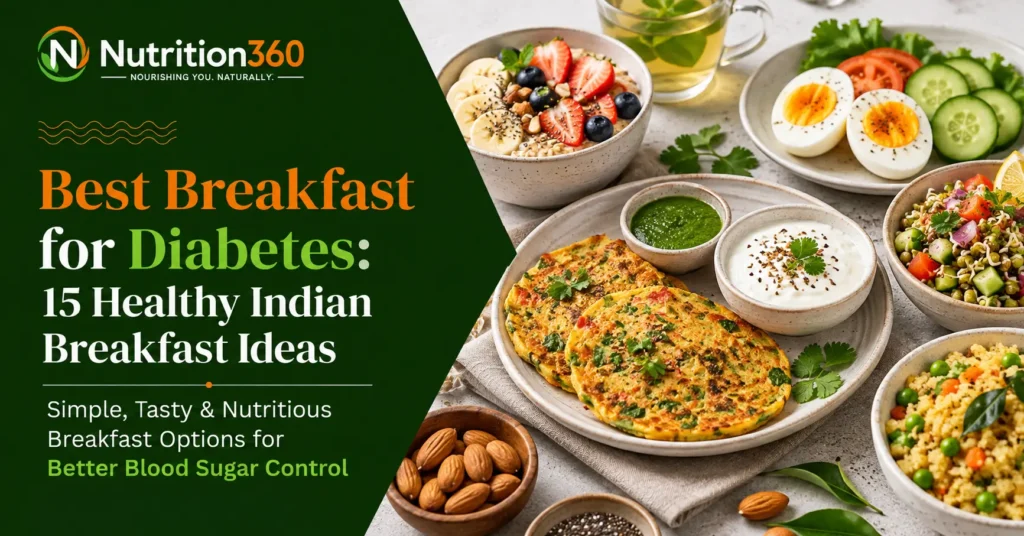
Best Breakfast for Diabetes: 15 Healthy Indian Breakfast Ideas
Table of Contents
ToggleChoosing the right breakfast can make a meaningful difference to how you manage your blood sugar throughout the morning. For people with diabetes, a balanced breakfast generally works best when it combines protein, fibre, healthy fats and controlled portions of carbohydrate, rather than relying mainly on refined carbohydrates or added sugar.
The good news is that managing diabetes does not mean giving up Indian food. Eggs, paneer, besan, moong dal, vegetables, curd, whole grains, nuts and seeds can all be used to create satisfying, practical breakfast options.
At Nutrition360, we focus on personalized nutrition rather than giving everyone the same diet chart. Your ideal breakfast can depend on your blood glucose response, medicines, activity level, weight goals, food preferences and overall health.
If you need individualized guidance, explore our Diabetes Dietitian in Noida program for personalized diabetes nutrition support.
What Is the Best Breakfast for Diabetes?
The best breakfast for diabetes is generally one that provides a balanced combination of protein, fibre, healthy fats and an appropriate amount of carbohydrates.
Instead of looking for one “perfect” diabetic breakfast, focus on building meals that are nutritious, filling and appropriate for your individual glucose response.
A diabetes-friendly breakfast may include:
- A good source of protein such as eggs, paneer, curd, tofu or dal
- Fibre-rich vegetables
- Whole or minimally processed carbohydrate sources
- Nuts and seeds in appropriate portions
- Minimal added sugar
- Limited refined flour and highly processed breakfast foods
For example, moong dal chilla with paneer and vegetables provides a different nutritional profile from a breakfast consisting mainly of white bread, biscuits or a sugary cereal.
The exact amount and type of carbohydrate that works best can vary from person to person.
15 Healthy Indian Breakfast Ideas for Diabetes
1. Moong Dal Chilla with Paneer
Moong dal chilla is one of the most practical Indian breakfast options for people looking to increase protein and reduce dependence on refined breakfast foods.
Prepare chilla using soaked and blended moong dal and add vegetables such as:
- Spinach
- Capsicum
- Onion
- Tomato
- Coriander
Adding a paneer filling can further increase the protein content.
Better combination:
2 small moong dal chillas + paneer filling + mint/coriander chutney without added sugar.
Avoid using excessive oil while cooking.
2. Vegetable Besan Chilla
Besan chilla can be another convenient breakfast for people with diabetes.
Add vegetables such as spinach, methi, onion, tomato and capsicum to improve fibre and overall nutrient density.
Pair it with plain curd rather than sweetened sauces or packaged chutneys.
Breakfast idea:
2 small vegetable besan chillas + plain curd.
Portion requirements should still be individualized.
3. Vegetable Omelette
Eggs provide high-quality protein and contain very little carbohydrate.
A vegetable omelette made with eggs, spinach, tomato, capsicum, onion and mushrooms can therefore be a useful protein-rich breakfast.
Instead of pairing it with several slices of white bread, consider vegetables and a controlled portion of whole-grain carbohydrate where appropriate.
Breakfast idea:
2-egg vegetable omelette + sautéed vegetables + 1 small whole-grain roti/toast if suitable for your meal plan.
4. Paneer Bhurji with Vegetables
Paneer bhurji can provide protein and make breakfast more filling.
Prepare it with tomato, capsicum, onion, spinach and spices while keeping added oil moderate.
It can be paired with a small whole-wheat or multigrain roti depending on your carbohydrate requirements.
Breakfast idea:
Paneer bhurji + vegetables + 1 small roti.
5. Sprouts and Vegetable Bowl
A bowl containing sprouts and vegetables can provide fibre, plant protein and micronutrients.
You can combine:
- Moong sprouts
- Cucumber
- Tomato
- Capsicum
- Coriander
- Lemon
- A small quantity of peanuts or seeds
People who experience digestive discomfort with raw sprouts can use properly cooked or steamed sprouts instead.
6. Greek Yogurt or Plain Curd with Nuts and Seeds
Unsweetened curd or Greek yogurt can form the base of a quick breakfast.
Add small portions of:
- Almonds
- Walnuts
- Chia seeds
- Flaxseeds
- Pumpkin seeds
If fruit is included, choose an appropriate portion rather than adding fruit juice, honey or sugar.
Always check packaged yogurt labels because flavoured varieties can contain significant amounts of added sugar.
7. Paneer and Vegetable Stuffed Roti
Instead of a traditional paratha prepared with generous amounts of oil or ghee, try a thinner whole-wheat roti filled with paneer and vegetables.
Good filling options include paneer with methi, spinach, cabbage or capsicum.
Pair it with plain curd.
The portion of roti should be based on the individual’s carbohydrate needs and glucose response.
8. Egg Bhurji with Vegetables
Egg bhurji is quick, inexpensive and protein rich.
Add vegetables such as:
- Tomato
- Onion
- Capsicum
- Spinach
- Coriander
Instead of eating it with several pieces of bread, combine it with vegetables and an appropriate portion of whole grain.
9. Tofu Bhurji
For people who prefer a plant-based breakfast, tofu bhurji can be a useful alternative.
Combine tofu with spinach, tomato, capsicum and other vegetables.
It provides protein without requiring a heavily carbohydrate-based breakfast.
10. Ragi Vegetable Chilla
Ragi can be incorporated into a diabetes diet, but it is important to remember that it still contains carbohydrate.
Rather than assuming that ragi is automatically “free” or unlimited because it is a millet, focus on portion size and what you eat alongside it.
Adding vegetables and a protein source such as curd or paneer can make the meal more balanced.
11. Mixed Dal Chilla
A combination of lentils can be used to prepare a protein- and fibre-containing chilla.
For example, you can use moong dal with another suitable dal and add vegetables.
Pair it with curd or paneer to further improve the meal’s protein content.
12. Vegetable Dalia with a Protein Side
Dalia can be included in some diabetes meal plans, but portion size matters.
Prepare it with plenty of non-starchy vegetables rather than making the meal predominantly cereal based.
Adding plain curd, paneer or eggs on the side can improve the protein balance of the breakfast.
People should assess their individual glucose response because tolerance to cereal-based breakfasts varies.
13. Idli with Sambar — With Portion Control
People with diabetes do not necessarily have to eliminate idli completely.
However, a large portion of idli without sufficient protein or fibre may provide a relatively carbohydrate-heavy breakfast.
A more balanced approach could be a controlled serving of idli accompanied by vegetable-rich sambar rather than consuming several idlis alone.
Individual post-meal glucose response is important.
14. Vegetable Uttapam with Sambar
Vegetable uttapam can occasionally fit into a balanced diabetes meal plan when portion size is controlled.
Add vegetables generously and pair it with sambar.
Avoid assuming that foods are automatically diabetes friendly simply because they are homemade. Total carbohydrate quantity and the overall meal composition still matter.
15. Whole-Grain Toast with Egg or Paneer
When you need a quick breakfast, whole-grain toast paired with a protein source can be more balanced than toast with jam or sweet spreads.
Try:
Option 1: Whole-grain toast + boiled eggs + cucumber and tomato
Option 2: Whole-grain toast + paneer + vegetables
Read the ingredient list when buying bread because terms such as “brown bread” do not necessarily mean that a product is predominantly whole grain.
What Should a Diabetes-Friendly Breakfast Plate Look Like?
A simple way to think about breakfast is to include protein + fibre-rich foods + a controlled carbohydrate portion.
For example:
Protein: Eggs, paneer, tofu, curd, dal or sprouts
Fibre: Spinach, tomato, capsicum, cucumber, methi and other vegetables
Carbohydrate: Whole-grain roti, dal-based chilla, appropriate cereal portions or other minimally processed options
Healthy fats: Nuts and seeds in moderate quantities
There is no universal portion size that is suitable for every person with diabetes.
High-Protein Breakfast for Diabetes
Protein can help improve satiety and makes it easier to build a balanced meal rather than consuming a breakfast dominated by refined carbohydrates.
Indian protein-rich breakfast ingredients include:
- Eggs
- Paneer
- Tofu
- Moong dal
- Besan
- Sprouts
- Unsweetened curd
- Greek yogurt
- Nuts and seeds
For example, instead of eating toast alone, adding eggs and vegetables creates a more nutritionally balanced breakfast.
Low-GI Breakfast for Diabetes: Is GI Enough?
The glycemic index (GI) describes how quickly carbohydrate-containing foods can raise blood glucose under standardized conditions.
However, GI should not be the only factor used to choose breakfast.
Your glucose response is also affected by:
- Portion size
- Total carbohydrate
- Protein
- Fibre
- Fat
- Food preparation
- Physical activity
- Medicines
- Individual metabolic response
Therefore, a food labelled “low GI” should not automatically be eaten in unlimited quantities.
Foods to Limit at Breakfast When You Have Diabetes
Rather than creating a long list of completely forbidden foods, pay particular attention to foods containing significant amounts of added sugar, refined carbohydrates or highly processed ingredients.
Examples include:
- Sugary breakfast cereals
- Sweetened flavoured yogurt
- Biscuits
- Cakes and pastries
- Sweetened tea or coffee
- Packaged fruit juice
- Sugary beverages
- White bread with jam
- Sweet spreads
- Large portions of refined-flour breakfast foods
Even foods marketed as “diabetic,” “multigrain,” “healthy” or “sugar-free” should be checked carefully for their complete ingredient list and nutritional information.
Is Fruit Good for Breakfast in Diabetes?
Whole fruit can be included in many diabetes meal plans.
The important distinction is between whole fruit and fruit juice.
Whole fruits retain their natural fibre, whereas juices can make it easy to consume a larger amount of carbohydrate quickly and generally contain less intact fibre.
Depending on individual requirements, breakfast fruit options may include appropriate portions of:
- Apple
- Pear
- Orange
- Guava
- Papaya
- Berries
Fruit portions and glucose responses can vary considerably, so personalized guidance may be useful.
Can People with Diabetes Drink Tea or Coffee at Breakfast?
Tea and coffee can often be included, but pay attention to what is added.
Large amounts of sugar, syrups or sweetened creamers can significantly change the nutritional profile.
Try gradually reducing added sugar if you currently prefer very sweet tea or coffee.
Why Breakfast Needs to Be Personalized in Diabetes
There is no single “diabetes breakfast” that works equally well for everyone.
Two people can eat the same meal and experience different post-meal glucose responses.
Breakfast planning may need to consider:
- Type of diabetes
- Blood glucose patterns
- HbA1c
- Diabetes medicines
- Insulin use
- Body weight and weight goals
- Physical activity
- Work schedule
- Kidney or cardiovascular conditions
- Food preferences
- Vegetarian or non-vegetarian diet
- Other medical conditions
This is why copying a generic diabetes diet chart from the internet may not provide the same benefit as an individualized nutrition plan.
For personalized support, you can consult a Diabetes Dietitian in Noida at Nutrition360 for a plan designed around your lifestyle, food preferences and health requirements.
Sample Indian Breakfast Combinations for Diabetes
Here are a few simple combinations:
Breakfast | Protein Source | Fibre/Vegetables |
Moong dal chilla + paneer | Dal + paneer | Spinach/capsicum |
Vegetable omelette | Eggs | Mixed vegetables |
Besan chilla + curd | Besan + curd | Mixed vegetables |
Paneer bhurji + small roti | Paneer | Spinach/capsicum |
Tofu bhurji | Tofu | Mixed vegetables |
Sprout bowl | Sprouts | Cucumber/tomato |
Plain curd + seeds + suitable fruit | Curd | Fruit/seeds |
These are examples rather than individualized prescriptions. Portion requirements vary between individuals.
- Mansee
There is no single best breakfast for everyone with diabetes. A balanced breakfast usually combines protein, fibre-rich foods, healthy fats and an individualized amount of carbohydrate. Options such as moong dal chilla with paneer, vegetable omelette, besan chilla with curd or paneer bhurji with vegetables can be considered.
A good Indian breakfast for Type 2 diabetes can include moong dal chilla, besan chilla, eggs with vegetables, paneer bhurji, tofu bhurji, sprouts or unsweetened curd with nuts and seeds. The best option depends on portion size, medication, activity, weight goals and individual glucose response.
There is no requirement for everyone with diabetes to eat a particular food immediately after waking. Breakfast timing and composition should fit the person’s medication schedule, glucose levels and routine. When breakfast is eaten, including protein and fibre rather than relying mainly on refined carbohydrates can help create a more balanced meal.
Eggs contain protein and very little carbohydrate, so they can fit into many diabetes meal plans. They can be combined with vegetables to create a balanced breakfast. Individual dietary recommendations may differ for people with other health conditions, so overall diet quality remains important.
Poha is primarily a carbohydrate-containing food. It does not necessarily need to be completely avoided, but portion size and meal composition matter. Adding vegetables, peanuts and an appropriate protein source can improve the overall meal. Individual glucose responses should also be considered.
Traditional semolina upma contains a substantial carbohydrate component. If included, portions should be appropriate and vegetables and protein should be added where possible. Some people may experience a greater post-meal glucose rise than others, so monitoring individual response can be useful.
Idli can be included in some diabetes meal plans, but quantity matters. Eating multiple idlis alone may produce a carbohydrate-heavy meal. A controlled portion paired with vegetable-rich sambar can provide a more balanced option.
Protein-rich options include egg and vegetable omelette, paneer bhurji, tofu bhurji, moong dal chilla, besan chilla with curd and sprouts. The complete meal and portion size should still be considered.
Bananas do not automatically need to be eliminated from a diabetes diet. The appropriate portion depends on factors such as the size and ripeness of the banana, the rest of the meal and individual glucose response. Whole fruit is generally preferable to fruit juice.
Fruit juice is generally less preferable than whole fruit for routine consumption because juicing removes much of the intact fibre and makes it easier to consume larger quantities quickly. Whole fruit in an appropriate portion is usually a more practical choice.
There is no single atta that can control diabetes by itself. Whole-grain and higher-fibre options can be considered, but portion size, total carbohydrate and the foods eaten with the roti are equally important. Labels such as “multigrain” should not be treated as a guarantee that a product is appropriate for unlimited consumption.
Yes, bread can fit into some diabetes meal plans. Choose a product with whole grains and review the ingredient list. Pairing a controlled portion with protein such as eggs or paneer and vegetables is generally more balanced than eating bread with jam or sugary spreads.
There is no universal list that every person must completely avoid. However, breakfasts high in added sugar and refined carbohydrates—such as sugary cereals, pastries, biscuits, sweetened beverages and large quantities of white bread—are worth limiting.
Including adequate protein at breakfast can improve satiety and help create a balanced meal. Eggs, paneer, tofu, dal, sprouts and unsweetened curd are useful Indian options. Protein requirements should be individualized, particularly for people with kidney disease or other medical conditions.
For someone managing both diabetes and body weight, breakfast should emphasize protein, fibre, vegetables and appropriate portions while keeping overall calorie and carbohydrate intake aligned with their individual requirements. Moong dal chilla with paneer, vegetable omelette, tofu bhurji or unsweetened curd with nuts and seeds are examples.
Skipping breakfast is not automatically beneficial or harmful for everyone with diabetes. The effect depends on medications, insulin use, glucose patterns, overall eating schedule and individual health. People taking glucose-lowering medication should discuss significant changes to meal timing with their doctor or dietitian.
When advised by your healthcare professional, checking glucose before and after meals can help show how particular meals affect you. People using a continuous glucose monitor may also observe meal-related patterns. Interpretation should consider medication, activity and other factors rather than judging one reading in isolation.
Nutrition is an important component of diabetes management. A qualified dietitian can help translate general nutrition recommendations into an individualized eating plan based on your glucose levels, medications, food preferences, weight goals, lifestyle and other medical considerations.
If you are looking for personalized guidance, learn more about Nutrition360’s Diabetes Diet Program and diabetes nutrition consultation.
Build a Diabetes Diet Around Your Lifestyle
Managing diabetes does not mean surviving on bland food or eliminating every carbohydrate from your diet.
The goal is to build an eating pattern you can realistically maintain while considering carbohydrate quantity and quality, protein, fibre, portions, meal timing and your individual blood glucose response.
Your breakfast can still include familiar Indian foods. The key is choosing appropriate ingredients, portions and combinations.
If you’re unsure what to eat because your blood sugar remains difficult to manage despite trying different diet charts, personalized nutrition guidance can help identify a more suitable approach.
Consult a Diabetes Dietitian at Nutrition360 for personalized diabetes nutrition guidance in Noida and online.
Medical disclaimer: This article is for general educational purposes and is not a substitute for individualized medical advice. Diabetes medications or insulin should not be changed based on dietary information online. Consult your doctor and qualified dietitian for recommendations appropriate to your health condition.
Other Blogs
Discover a practical PCOS diet plan for women in Noida Extension with balanced Indian meals, vegetarian options, healthy food choices, and easy tips for managing...
Read More
Discover a practical PCOS diet plan for women in Noida Extension with balanced Indian meals, vegetarian options, healthy food choices, and easy tips for managing...
Read More
Looking for a fatty liver dietitian in Noida? Discover the best foods to eat and avoid, Indian diet tips, healthy meal choices, and practical nutrition...
Read More
Mansee Chauhan is the Head Nutritionist at Nutrition360, Greater Noida West, dedicated to providing personalized, evidence-based nutrition guidance for individuals seeking sustainable improvements in their health and lifestyle. She focuses on creating practical diet plans tailored to individual health goals, dietary preferences, lifestyle patterns, and nutritional needs. Her areas of nutrition expertise include weight management, diabetes-friendly nutrition, gut health, hormonal wellness, fitness nutrition, and overall healthy living. Through personalized nutrition counselling and structured dietary guidance, Mansee Chauhan helps individuals develop healthier eating habits and make sustainable lifestyle changes for long-term well-being.