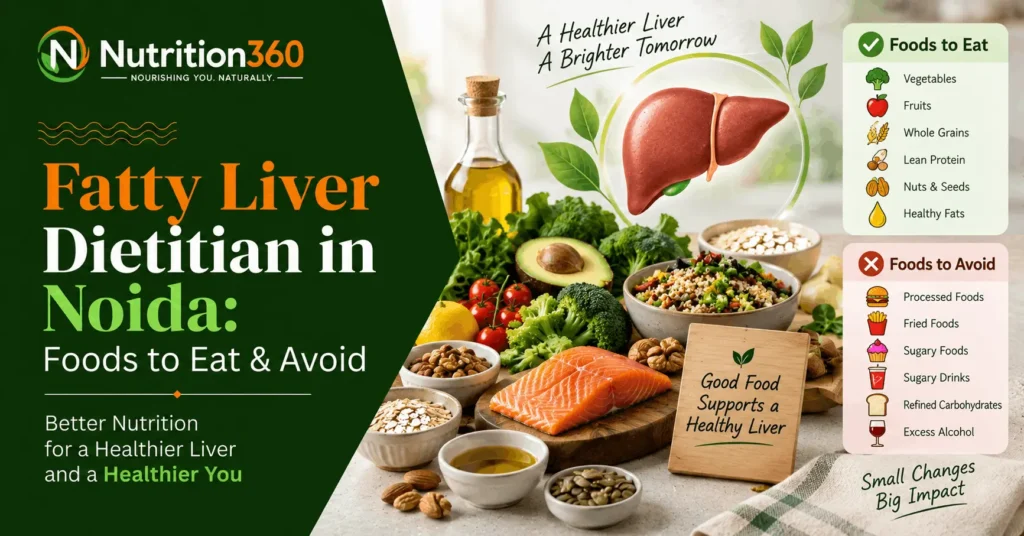
Fatty Liver Dietitian in Noida: Foods to Eat & Avoid
Table of Contents
ToggleFatty liver is increasingly associated with modern lifestyle factors such as excess body weight, sedentary habits, insulin resistance, type 2 diabetes, high cholesterol, and diets high in refined carbohydrates and processed foods.
The condition is now commonly referred to as metabolic dysfunction-associated steatotic liver disease (MASLD); the older term non-alcoholic fatty liver disease (NAFLD) is still widely used.
The good news is that nutrition, physical activity, weight management, and improvements in metabolic health can play an important role in managing fatty liver.
If you are looking for a fatty liver dietitian in Noida, understanding what to eat, what to limit, and how to build a sustainable diet is an important place to start.
At Nutrition360, dietary plans are personalised according to your health goals, lifestyle, food preferences, weight, medical history, and metabolic health rather than relying on highly restrictive or one-size-fits-all diets.
What Is Fatty Liver Disease?
Fatty liver occurs when excess fat accumulates inside liver cells.
Many people with early fatty liver have no noticeable symptoms. It may be detected during routine blood tests, an ultrasound, or investigations performed for another health concern.
Fatty liver is particularly associated with metabolic factors such as:
- Being overweight or having obesity
- Excess abdominal fat
- Insulin resistance
- Type 2 diabetes
- High triglycerides or abnormal cholesterol
- Physical inactivity
- Diets high in refined carbohydrates and sugary foods
- Frequent consumption of ultra-processed foods
Some people can develop fatty liver even when their body weight appears to be within a healthy range.
Can Diet Help With Fatty Liver?
Yes. Diet and lifestyle modification are important parts of fatty liver management.
A healthy eating pattern can support:
- Gradual weight management
- Better blood glucose control
- Improved insulin sensitivity
- Healthier cholesterol and triglyceride levels
- Reduced intake of added sugar and saturated fat
- Better overall metabolic and cardiovascular health
For people who are overweight, sustained weight reduction can substantially improve liver health. Even modest weight loss may reduce liver fat, while larger sustained reductions may improve inflammation and fibrosis.
The goal, however, should usually be gradual and sustainable weight loss rather than crash dieting.
Best Diet for Fatty Liver
There is no single food that can “detox” or cure fatty liver.
Instead, the overall dietary pattern matters.
A Mediterranean-style eating pattern is commonly recommended for people with fatty liver. For an Indian diet, the same principles can be adapted using familiar foods such as vegetables, dal, beans, whole grains, nuts, seeds, curd, paneer in appropriate portions, and other minimally processed foods.
Your diet should generally emphasise:
- Vegetables
- Whole fruits
- Legumes and pulses
- Whole grains
- Adequate protein
- Nuts and seeds
- Healthy unsaturated fats
- Minimally processed foods
At the same time, added sugars, sugary beverages, refined carbohydrates, excessive saturated fat, processed meat, and ultra-processed foods should be limited.
Foods to Eat for Fatty Liver
1. Plenty of Vegetables
Vegetables provide fibre, vitamins, minerals, and beneficial plant compounds while generally being relatively low in calories.
Include vegetables such as:
- Spinach
- Methi
- Bathua
- Broccoli
- Cauliflower
- Cabbage
- Capsicum
- Beans
- Carrots
- Cucumber
- Tomato
- Bottle gourd
- Ridge gourd
- Pumpkin
- Okra
Try to include vegetables at lunch and dinner rather than treating them as a small side dish.
2. Whole Fruits
People with fatty liver do not generally need to eliminate fruit.
Whole fruit provides fibre and nutrients and is preferable to fruit juice.
Depending on your individual health needs, options may include:
- Apple
- Guava
- Orange
- Papaya
- Pear
- Berries
- Pomegranate
Portion size and total carbohydrate intake may need additional consideration if you also have diabetes or insulin resistance.
Choose whole fruit instead of packaged or freshly extracted fruit juice whenever possible.
3. Protein-Rich Foods
Adequate protein helps support muscle mass and can improve satiety.
Vegetarian and egg-based protein options can include:
- Dal
- Moong
- Masoor
- Rajma
- Chana
- Chickpeas
- Soybeans
- Tofu
- Paneer in suitable portions
- Unsweetened curd
- Eggs
- Nuts and seeds
The right amount of protein varies depending on body weight, age, activity level, kidney health, and other medical conditions.
4. High-Fibre Carbohydrates
Carbohydrates do not necessarily need to be eliminated in fatty liver.
The quality and quantity of carbohydrates matter.
Prefer options such as:
- Whole-wheat roti
- Multigrain roti
- Barley
- Oats
- Dalia
- Brown rice
- Quinoa
- Millets
- Whole pulses
Portions should be adjusted according to your calorie requirements, blood sugar levels, activity, and weight-management goals.
5. Nuts and Seeds
Nuts and seeds can provide unsaturated fats, protein, fibre, and micronutrients.
Examples include:
- Almonds
- Walnuts
- Flaxseeds
- Chia seeds
- Pumpkin seeds
- Sunflower seeds
They are nutritious but calorie-dense, so portion size still matters.
6. Healthy Fats
Rather than eliminating fat completely, focus on improving fat quality.
Use oils in controlled quantities and include unsaturated fat sources such as nuts and seeds.
Try to reduce frequent consumption of foods rich in saturated or trans fats.
Foods to Avoid or Limit With Fatty Liver
Sugary Drinks
One of the simplest changes you can make is reducing sugar-sweetened beverages.
Limit:
- Soft drinks
- Sweetened packaged juices
- Energy drinks
- Sweetened iced tea
- Sweetened coffee beverages
- Sugary shakes
Water, unsweetened beverages, or other low-sugar alternatives are generally better choices.
Sweets and Added Sugar
Frequent consumption of foods high in added sugar can make calorie and blood-sugar management more difficult.
Limit:
- Mithai
- Cakes
- Pastries
- Cookies
- Chocolate
- Ice cream
- Sweetened breakfast cereals
- Desserts
You don’t necessarily need to label foods as permanently forbidden. Frequency and portion size matter.
Refined Carbohydrates
Reduce frequent consumption of highly refined carbohydrate foods such as:
- Maida products
- White bread
- Bakery products
- Biscuits
- Noodles made primarily from refined flour
- Sugary cereals
Choose higher-fibre alternatives when practical.
Deep-Fried Foods
Limit foods such as:
- Samosa
- Kachori
- Poori
- Pakora
- French fries
- Bhatura
- Deep-fried snacks
These foods can be highly calorie-dense and may contain significant amounts of saturated fat.
Ultra-Processed Foods
Try to reduce:
- Packaged chips
- Instant snacks
- Sugary breakfast cereals
- Processed bakery products
- Fast food
- Highly processed ready-to-eat meals
Home-cooked meals based around minimally processed ingredients can make it easier to control calories, sugar, fat, and portion sizes.
Indian Fatty Liver Diet Plan: Sample Day
A fatty liver meal plan should ideally be personalised rather than copied from the internet. However, a balanced day might look like this:
Early Morning
Water followed by a normal breakfast rather than relying on “detox” drinks.
Breakfast
Vegetable besan chilla with curd
OR
Vegetable omelette with whole-grain toast
OR
Moong dal chilla with vegetables
Mid-Morning
One portion of whole fruit.
Lunch
Salad or cooked vegetables + dal/rajma/chana + vegetable sabzi + controlled portion of whole-wheat roti or another whole grain + unsweetened curd.
Evening Snack
Unsweetened tea/coffee with a small portion of roasted chana or nuts.
Dinner
Vegetable sabzi + protein source such as dal, tofu, paneer or eggs + controlled portion of whole grains.
Dinner does not need to be carbohydrate-free. Portion size and overall daily intake are more important.
Fatty Liver and Weight Loss
For someone who is overweight, weight reduction can be one of the most important interventions for fatty liver.
Research and clinical guidance indicate that approximately 5–10% sustained weight loss can improve liver fat and inflammation, with greater reductions sometimes producing additional improvement.
However, faster is not necessarily better.
Crash diets and unnecessarily restrictive plans can be difficult to sustain and may lead to nutritional inadequacy or loss of muscle mass.
A dietitian can help establish a realistic calorie deficit while maintaining adequate protein and nutrition.
Fatty Liver and Diabetes
Fatty liver and type 2 diabetes commonly occur together.
Insulin resistance can contribute to fat accumulation in the liver, while the presence of fatty liver is also associated with broader metabolic risk.
If you have both diabetes and fatty liver, your diet may need to address several factors simultaneously:
- Total carbohydrate intake
- Carbohydrate quality
- Meal portions
- Protein intake
- Fibre
- Weight management
- Blood glucose patterns
- Cholesterol and triglycerides
This is one reason personalised nutrition can be more useful than simply following a generic “fatty liver diet chart.”
Fatty Liver and Exercise
Diet is only one part of fatty liver management.
Regular physical activity can help improve metabolic health and reduce liver fat.
A commonly recommended target for adults is around 150 minutes of moderate-intensity physical activity per week, depending on your medical condition and physical ability.
Combining aerobic exercise with resistance or strength training can be beneficial.
If you have an existing medical condition or have been inactive for a long time, discuss an appropriate exercise plan with your healthcare professional.
Do You Need to Completely Stop Eating Rice?
Not necessarily.
Having fatty liver does not automatically mean rice must be removed from your diet.
Instead, consider:
- Portion size
- Total daily carbohydrate intake
- What you eat with the rice
- Your blood glucose response
- Overall calorie requirements
Pairing a controlled portion of rice with vegetables and protein can make the meal more balanced.
People with diabetes or significant insulin resistance may need more individualised carbohydrate planning.
Is Roti Good for Fatty Liver?
Roti can be included in a fatty liver diet.
Whole-wheat roti is generally preferable to highly refined flour-based alternatives, but portion size remains important.
Eating five or six rotis simply because they are made from whole wheat can still contribute a substantial amount of calories.
A balanced plate with vegetables, protein and an appropriate portion of roti is a better approach.
Is Fruit Good for Fatty Liver?
Whole fruits can form part of a healthy fatty liver diet.
Fruit juice is different because juicing removes much of the fibre and makes it easier to consume a larger amount of sugar quickly.
Choose whole fruits and control portions, particularly if you have diabetes.
What About Alcohol?
Alcohol can worsen liver damage in some people.
The appropriate recommendation depends on the type and severity of your liver disease and your medical history. People with significant fibrosis or cirrhosis may be advised to avoid alcohol completely.
Discuss alcohol consumption with your hepatologist or treating doctor rather than assuming that a particular amount is safe for you.
Why Consult a Fatty Liver Dietitian in Noida?
Searching for a fatty liver dietitian near me often means you want more than a generic food chart.
A personalised nutrition consultation can take into account:
- Your current weight and waist circumference
- Weight-loss goals
- Food preferences
- Vegetarian or non-vegetarian diet
- Work schedule
- Physical activity
- Diabetes or prediabetes
- PCOS
- Thyroid disorders
- High cholesterol or triglycerides
- Blood pressure
- Relevant medical reports and medications
This allows dietary changes to fit your actual lifestyle rather than forcing you to follow an unrealistic meal plan.
Personalised Fatty Liver Nutrition at Nutrition360
At Nutrition360, the focus is on practical, sustainable nutrition that can fit into your everyday routine.
Your nutrition plan can be personalised according to your health goals, eating habits, lifestyle, food preferences and relevant medical conditions.
Whether your goal is weight management, better metabolic health, improved eating habits, or nutritional support alongside medical treatment for fatty liver, a structured diet plan can help you make consistent changes.
Nutrition360 offers nutrition consultation for people in Noida, Noida Extension, Greater Noida and surrounding Delhi NCR areas, along with online consultation options.
When Should You See a Doctor?
Dietary changes should complement—not replace—appropriate medical evaluation.
Speak with a doctor if you have abnormal liver tests or have been diagnosed with fatty liver. Specialist assessment may be particularly important if there is concern about fibrosis or advanced liver disease.
Seek prompt medical attention if you develop symptoms such as yellowing of the skin or eyes, significant abdominal swelling, vomiting blood, black stools, or new confusion.
People with advanced liver disease or cirrhosis may have very different nutritional requirements and should not follow a generic weight-loss or fatty-liver diet without professional medical and dietetic advice.
- Mansee
A balanced dietary pattern rich in vegetables, whole fruits, legumes, whole grains, appropriate protein, nuts, seeds and unsaturated fats is generally recommended. Mediterranean-style dietary patterns have particularly strong support and can be adapted to Indian foods.
Early-stage fatty liver can improve substantially with lifestyle changes in many people. Weight management, improved diet quality, regular physical activity and management of diabetes, cholesterol and other metabolic risk factors are important. The potential for improvement depends partly on the severity of liver disease.
Limit sugar-sweetened beverages, foods high in added sugar, refined carbohydrates, deep-fried foods, excessive saturated fat and ultra-processed foods. Alcohol intake should be discussed with your treating doctor.
Vegetables, dal, chana, rajma, whole grains, whole fruits, unsweetened curd, tofu, eggs, nuts and seeds can all form part of an Indian fatty liver diet when portions are appropriate.
Rice does not automatically need to be eliminated. The amount eaten, overall diet, calorie intake and blood glucose control matter. A dietitian can help determine an appropriate portion.
Whole-wheat roti can be included as part of a balanced diet. Combine it with vegetables and protein and keep the portion appropriate for your individual calorie and carbohydrate requirements.
Whole fruits such as apples, guava, oranges, pears, papaya and berries can be included. Whole fruit is generally preferable to juice. Individual portions may need adjustment for people with diabetes.
Eggs can provide high-quality protein and may fit into a balanced diet. The appropriate quantity depends on your overall dietary pattern, calorie needs and medical profile.
Paneer can provide protein but can also contain substantial saturated fat depending on how it is made. Portion size and the type of paneer should therefore be considered as part of the overall diet.
If you are overweight, even modest sustained weight loss can reduce liver fat. Clinical guidance commonly associates approximately 5–10% weight reduction with meaningful improvements, although the appropriate target should be individualised.
Regular physical activity, including brisk walking, can contribute to better metabolic health and help reduce liver fat. Adults are commonly encouraged to work toward around 150 minutes of moderate activity per week when medically appropriate.
Some people may use time-restricted eating as a strategy to manage overall calorie intake, but it is not essential for treating fatty liver and is not suitable for everyone. People taking diabetes medicines, pregnant women, and people with certain medical conditions should seek professional advice before fasting.
No. Rather than eliminating carbohydrates, focus on appropriate portions and higher-fibre, minimally processed carbohydrate sources while reducing refined carbohydrates and added sugars.
There is no need to depend on special detox juices or drinks to “clean” the liver. Sustainable dietary improvements, physical activity, weight management where needed, and appropriate medical care are more important.
Yes. A qualified dietitian can help develop an individualised eating plan that considers your weight, lifestyle, food preferences and associated conditions such as diabetes, insulin resistance, high cholesterol or hypertension.
Look for a qualified dietitian who has experience with weight management and metabolic conditions and who provides personalised nutrition rather than a standard diet chart. Nutrition360 provides personalised nutrition consultations in Noida and nearby areas, as well as online consultations.
Book a Personalised Fatty Liver Nutrition Consultation With Fatty Liver Dietitian in Noida
If you have been diagnosed with fatty liver and are unsure about what to eat, what to avoid, or how to lose weight safely, personalised nutrition guidance can help you create a more practical long-term plan.
Nutrition360 provides personalised diet consultations for fatty liver, weight management, diabetes, PCOS, high cholesterol and other nutrition-related health goals in Noida, Noida Extension, Greater Noida and online.
Book your consultation with Nutrition360 and take the next step towards healthier eating and better metabolic health.
Medical Disclaimer: This article is for general educational purposes and is not a substitute for diagnosis or treatment by a doctor. Dietary requirements can differ significantly in advanced liver disease, cirrhosis, diabetes, kidney disease, pregnancy and other medical conditions.
Other Blogs
Discover a practical PCOS diet plan for women in Noida Extension with balanced Indian meals, vegetarian options, healthy food choices, and easy tips for managing...
Read More
Discover a practical PCOS diet plan for women in Noida Extension with balanced Indian meals, vegetarian options, healthy food choices, and easy tips for managing...
Read More
Looking for a fatty liver dietitian in Noida? Discover the best foods to eat and avoid, Indian diet tips, healthy meal choices, and practical nutrition...
Read More
Mansee Chauhan is the Head Nutritionist at Nutrition360, Greater Noida West, dedicated to providing personalized, evidence-based nutrition guidance for individuals seeking sustainable improvements in their health and lifestyle. She focuses on creating practical diet plans tailored to individual health goals, dietary preferences, lifestyle patterns, and nutritional needs. Her areas of nutrition expertise include weight management, diabetes-friendly nutrition, gut health, hormonal wellness, fitness nutrition, and overall healthy living. Through personalized nutrition counselling and structured dietary guidance, Mansee Chauhan helps individuals develop healthier eating habits and make sustainable lifestyle changes for long-term well-being.